Worn teeth · Bruxism · Implants · All-on-4
Full Mouth Rehabilitation in Medellín
I rebuild the whole mouth when many teeth are missing, badly damaged or worn down by bruxism. One plan, designed digitally, that restores function, esthetics and the confidence to chew without fear.
How much does a full mouth rehabilitation cost in Medellín?
On implants, a full mouth rehabilitation in Medellín costs from $15,000,000 COP per arch, with a permanent fixed prosthesis. If your teeth can be kept, they are rebuilt with crowns or veneers and the price depends on how many teeth and the material. In both cases the exact price is set at your assessment.
What is full mouth rehabilitation?
It is the complete reconstruction of the mouth when the problem is no longer one tooth but the whole system: the bite, the height of the teeth, the esthetics and the way both arches work together. It combines crowns, veneers, implants and fixed prostheses in a single, coherent plan.
The difference from treating tooth by tooth is the order. First we understand why the mouth reached this point, then we design the final result, and only then do we begin. That way the treatment does not break down a few years later for the same reason that damaged the original teeth.
Rehabilitation on your own teeth or on implants?
Not every full mouth rehabilitation is the same. The first question is whether your teeth can be kept. When they can, keeping them is almost always the best option.
Rehabilitation on your own teeth
For teeth that are worn, fractured or have failing restorations, but still have healthy roots. They are rebuilt with crowns and veneers in zirconia or lithium disilicate, restoring lost height and a stable bite.
Rehabilitation on implants
When most teeth are missing or the remaining ones cannot be saved. A complete fixed prosthesis on 4 or 6 implants, with a same-day provisional when the case allows it.
Teeth worn down by bruxism: how they are rebuilt
Bruxism, clenching or grinding your teeth, wears the enamel down for years without pain. By the time the patient notices, the teeth look short, the smile has aged, and sometimes there is no room left for a crown without removing more tooth. At that point it is not enough to "fix the teeth": the bite has to be rebuilt.
In these cases the work starts before touching a tooth. I carry out a complete occlusal and functional analysis to understand how the patient bites, how much height was lost and how much can be safely recovered. That is how the new vertical dimension, the height of the bite, is planned.
Occlusal and functional analysis
Study of the bite, jaw movements, muscles and joint. When there is a clinical indication a deprogrammer is used; it is not a mandatory step for everyone.
Both arches as one system
Even when the wear shows in one arch, I study how both fit together. Planning the relationship between them is what makes it possible to recover restorative space and build a stable bite.
Digital design and diagnostic wax-up
3D intraoral scan, photographs and design of the new tooth anatomy, the vertical dimension and the relationship between both arches before starting.
Provisionals that work as a prototype
They are not temporary crowns while you wait. In them we test and adjust bite height, contacts, front-teeth guidance, jaw movements, speech, chewing, muscular comfort and esthetics.
Resin try-in before the ceramics
Before the definitive restorations are made, shape, proportions, height and bite are checked in your mouth. The ceramics reproduce a bite that has already been tested, instead of adapting your bite to the ceramics.
Definitive restorations, tooth by tooth
Crown, veneer or onlay is decided for each tooth based on sound structure, enamel and the load it carries. Teeth that can be treated more conservatively are not turned into full crowns. The material, zirconia or lithium disilicate, is chosen for strength and not for esthetics alone.
Night guard and follow-up
Rebuilding the bite does not eliminate bruxism. That is why a night guard is delivered at the end, always included, and periodic check-ups are scheduled.
If you want to understand where the problem comes from, I explain it in the article on bruxism and rehabilitation.
How is full mouth rehabilitation different from All-on-4?
All-on-4 is one way of doing a full mouth rehabilitation, not a synonym for it. It is the solution when the arch no longer has teeth that can be saved: four implants are placed and a complete fixed prosthesis goes on top.
Full mouth rehabilitation is the broader concept. It can be done on your own teeth, on implants, or combining both in the same mouth. What decides the path is not the technique someone wants to sell, but how many teeth can be kept and the condition of the bone.
Who needs a full mouth rehabilitation?
- ✓Your teeth are badly worn from severe bruxism or chronic acid reflux.
- ✓Your teeth look shorter every year or your smile has aged.
- ✓You have had repeated failures with previous treatments on several teeth.
- ✓You have lost most or all of your teeth, for any reason.
- ✓You have worn a removable denture for years and want a fixed solution.
- ✓You need crowns, implants or extractions on several teeth at once.
When implants are the solution
From All-on-4 with immediate loading to zygomatic implants for cases with little bone.
All-on-4
A full arch on 4 implants: 2 vertical in front and 2 angled at the back. When the case allows it, the patient leaves with provisional teeth on the day of surgery.
All-on-6
6 implants to distribute forces better and give more support to the definitive prosthesis. Recommended when there is enough bone and maximum long-term stability is the goal.
Hybrid prosthesis
A full arch in high-strength resin with a metal framework, or in zirconia, on 4 to 6 implants. It replaces all the teeth in one arch.
Zygomatic implants
For severe bone loss in the upper jaw, when conventional implants are not possible. The implant is anchored in the cheekbone and avoids a bone graft.
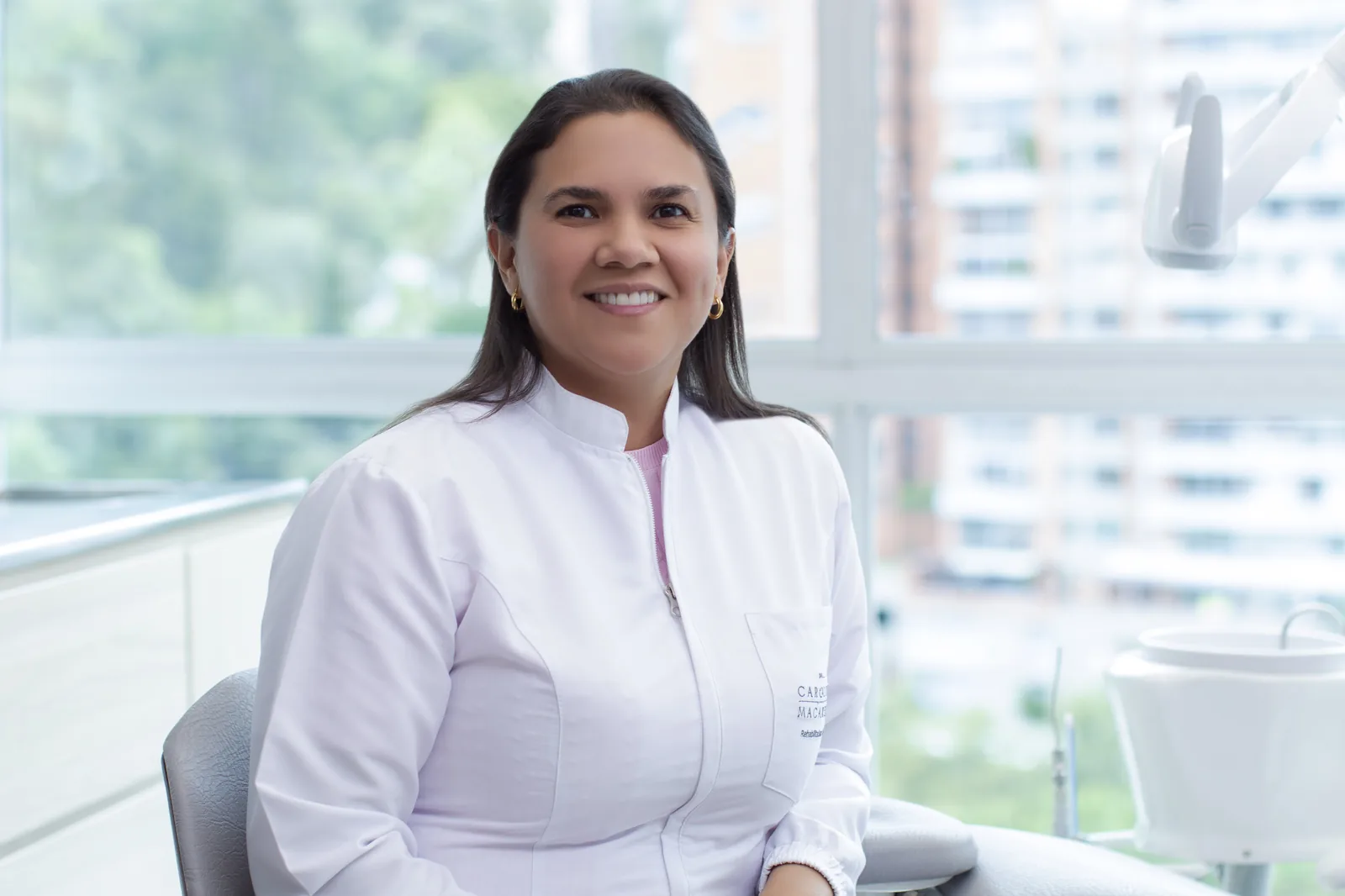
Wear and bruxism · Implants · All-on-4
The most complex case needs the most experience
Digital diagnosis and design
3D intraoral scan in the office, photographs and design of the result before starting. X-rays are not included in the assessment, but they are always required.
Oral rehabilitation specialist
More than 17 years of experience and advanced implant training (NEODENT/FACOP, Brazil).
Surgery planned as a team
Surgery is performed by Dr. Carolina or by the maxillofacial surgeon on the team, as defined when the case is planned.
International patients
We treat patients from the United States, Panama, Chile and Puerto Rico who travel to Medellín.
The implant process, step by step
3D diagnosis and digital planning
CT scan, intraoral scan, photographs and facial analysis. The final result is designed before starting.
Extractions and preparation
If some teeth cannot be saved, they are extracted and the bone is prepared to receive the implants.
Implant surgery
Implants are placed under local anesthesia or conscious sedation. It takes 2 to 4 hours depending on the case.
Immediate provisional prosthesis
In immediate-loading cases a fixed provisional prosthesis is placed the same day.
Osseointegration period
3 to 6 months while the implant integrates with the bone, with periodic check-ups.
Definitive rehabilitation
Fabrication and placement of the definitive prosthesis in zirconia or ceramic.
Treatment length
6 to 12 months
On implants, from
$15,000,000 COP per arch
Number of visits
6 to 8 visits
Frequently asked questions
▸How much does a full mouth rehabilitation cost in Colombia?
On implants, a full mouth rehabilitation costs from $15,000,000 COP per arch, depending on the number of implants, the type of prosthesis and case complexity. When it is done on your own teeth, the price depends on how many teeth are rebuilt and the material. In both cases the exact price is set at your assessment.
▸Can my teeth be saved if they are badly worn from bruxism?
Often, yes. If the roots are healthy, worn teeth are rebuilt with crowns or veneers that restore the lost height. First an occlusal and functional analysis is done to know how much height can be safely recovered.
▸What is vertical dimension and why does it matter?
It is the height of your bite. With bruxism wear that height is lost, the teeth look short and sometimes there is no room left to restore them. In the rehabilitation the new height is planned and tested first in the provisionals before the definitive restorations are made.
▸What are the provisionals for?
They work as the prototype of the final rehabilitation. In them we evaluate and adjust bite height, contacts, front-teeth guidance, speech, chewing and esthetics. Once everything works, they are copied into the definitive material.
▸Do I need to wear a deprogrammer before rehabilitation?
Not always. A deprogrammer is used to obtain a stable, reproducible jaw position when the existing bite does not give a reliable reference. So it is indicated by what the examination of the joints, muscles and bite shows, not as an automatic step for every patient with bruxism. Nor is it defined by a fixed number of days: the goal is to obtain reliable records.
▸If the wear is on my lower teeth, why study both arches?
Because both arches work as one system. The upper crowns may have marginal discrepancies, and the way both arches fit together defines the final bite. Studying them together makes it possible to recover restorative space and build a stable bite. It does not automatically mean crowning every tooth.
▸Will every tooth get a crown?
Not necessarily. Crown, veneer or onlay is decided tooth by tooth, based on how much sound structure and enamel remains, existing restorations and the load each tooth carries. Teeth that can be restored more conservatively are not turned into full crowns.
▸Which X-rays do I need, and will I need root canals?
A panoramic gives general information, but a rehabilitation of this scope needs a complete periapical series, which shows each tooth individually. If you can, have it taken before your trip and send it; if not, it is taken here on the first day. Root canals are not done preventively: only where there is a clinical and radiographic indication, and sometimes that is only known once an old crown is removed.
▸How many days do I need to stay in Medellín for a rehabilitation on my own teeth?
About 10 to 12 days, provided the preliminary studies do not reveal anything that requires changing the plan. The first day is the examination and planning; the following days the provisionals are placed and adjusted, preparations and the resin try-in are done, and at the end the definitive restorations are cemented with a check-up before you travel home.
▸What follow-up do I get once I am back home?
There is a final check-up before your return trip. After that, two video follow-up appointments at 15 and 30 days, and a written summary of your entire treatment for your dentist at home.
▸Does rehabilitation cure bruxism?
No. Rebuilding the bite does not eliminate bruxism. That is why a night guard is delivered at the end, always included, and periodic check-ups are scheduled to protect the work over the long term.
▸How is it different from All-on-4?
All-on-4 is one form of full mouth rehabilitation on four implants, indicated when the arch has no teeth that can be saved. Full mouth rehabilitation is the broader concept: it can be done on your own teeth, on implants, or combining both.
▸Can I have teeth the same day as surgery?
On the implant path, with All-on-4 or All-on-6, a provisional prosthesis can be placed on the day of surgery when the case allows it. The definitive zirconia prosthesis is placed after the osseointegration period.
▸Is there an age limit for full mouth rehabilitation?
There is no age limit. What is evaluated is overall health. Patients over 70 or 80 are frequent candidates. The important thing is that general health is under control.
▸What if I lost all the bone in my upper jaw?
For severe bone loss there are zygomatic implants, anchored in the cheekbone and requiring no prior bone graft. They make it possible to rehabilitate even the most complex cases.
Start with the diagnosis
Every rehabilitation starts by understanding your case. Write to me and we will review which path suits you: keeping your teeth, implants or a combination.
Keep reading
Answer your questions before deciding
Oral Rehabilitation in Medellín: How to Choose the Right Specialist
A practical guide to choosing an oral rehabilitation specialist in Medellín: the 7 criteria to verify, the 10 exact questions to bring to your consultation, and the red flags to watch for before accepting a treatment plan.
Read articleImplantsImplant Overdenture: Options and Prices in Medellín
An implant overdenture is a removable denture that anchors to 2 or 4 implants: far more stable than a traditional plate and more affordable than a fixed prosthesis. I explain the four options, when each one is right and their real prices, from $3,500 to $5,000 USD per arch.
Read article