A practical guide to choosing an oral rehabilitation specialist in Medellín: the 7 criteria to verify, the 10 exact questions to bring to your consultation, and the red flags to watch for before accepting a treatment plan.
Choosing the right specialist matters more than choosing the city
For most people, a full oral rehabilitation is the largest investment they will ever make in their dental health. It is also one of the few dental decisions that is hard to reverse: when a rehabilitation is poorly planned, correcting it usually costs more than doing it properly the first time.
Medellín offers many options and almost all of them look good from the outside. This guide does not tell you who to choose. It gives you the criteria to evaluate anyone, including me, with the same questions.
What oral rehabilitation is (and when you actually need it)
Oral rehabilitation rebuilds the function and appearance of the whole mouth when the damage can no longer be solved one tooth at a time. It is not the same as a cosmetic treatment.
You probably need it if:
- You lost several teeth and the remaining ones are shifting.
- You wear a removable denture that no longer holds or that hurts.
- You have severe wear from bruxism and your teeth look short.
- You have had multiple crowns and bridges that keep failing.
- Your bite changed and you feel joint or facial muscle pain.
You probably do not need it if your only concern is the color or shape of your front teeth. That is a different treatment, shorter and less expensive. A good specialist will tell you so even if it means a smaller case.
The 7 criteria for choosing
1. Specific postgraduate training, not general dentistry
This is the most important filter. Oral rehabilitation is a formal postgraduate specialty. A general dentist can place implants, but planning a full mouth is a different discipline.
Ask where they did their specialization and in what year. In Colombia you can verify any dentist's professional registration in RETHUS, which is public and free.
2. A 3D diagnosis before any decision
No serious rehabilitation is planned from a flat X-ray. There must be a CBCT scan to assess available bone, nerves and sinuses, and an intraoral scan for digital planning.
If someone gives you a plan and a price without a 3D study, you do not have a plan. You have an estimate.
3. Who performs each part of the treatment
A complex rehabilitation is rarely performed by one person. There is usually a surgeon for the surgical phase, the rehabilitation specialist who designs and directs the case, and a laboratory that fabricates the prosthetics.
That is not a drawback, quite the opposite. What is a red flag is when nobody can tell you who does what.
4. Implant brand and laboratory, by name
Ask which implant system they use and which laboratory makes your prosthetics. Internationally recognized brands matter for a practical reason: ten years from now, if you need a component or a repair, any specialist in the world will be able to source the part.
With an untraceable brand, a minor problem becomes a serious one. If the clinic cannot name the brands they use, walk away.
5. A written plan with the complete price before starting
You should receive in writing the diagnosis, the phases, the timeline and the total cost. Including what is not included.
Price surprises halfway through treatment are not normal. They are either a planning failure or a commercial decision, and neither one works in your favor.
6. What happens afterward, in writing
A rehabilitation does not end the day you walk out with new teeth. Ask what warranty covers the prosthetics and the implants, how often follow-ups happen, what is covered and what is not, and what happens if something fractures.
If you are traveling from another city or country, also ask how remote follow-up is handled and what you would do if you need an adjustment while far away.
7. That they are willing to tell you no
This criterion appears on no checklist, and to me it is the most revealing one.
A specialist who accepts every case, who never proposes a simpler alternative and who never tells you "what you are asking for is not right for you", is not evaluating your case. They are selling.
The best consultations I have seen, both as a professional and as a patient, are the ones where someone says honestly: you do not need this yet.
The exact questions to bring to your consultation
Bring them written down. A good specialist answers them without discomfort.
- What is your formal specialization and at which university did you earn it?
- How many cases like mine have you treated?
- What diagnostic studies will you perform before defining the plan?
- Which implant brand do you use and why that one?
- Who performs the surgery and who makes the prosthesis?
- What is the total price and what is not included?
- What warranty do I have and how do follow-ups work?
- Is there a more conservative or less expensive option in my case?
- What happens if I do not like the result?
- Can I see cases of yours similar to mine?
Red flags
- A closed price by phone or WhatsApp, without having examined you.
- A treatment plan with no CBCT scan.
- Discounts for deciding today, or pressure to leave a deposit at the first visit.
- They cannot or will not name the implant brand.
- They promise an exact result before studying your case.
- Before and after photos that are not from the clinic.
- Nobody mentions risks, contraindications or alternatives.
- There is no follow-up plan.
A warning about price that cuts both ways. A figure far below market almost always means a cut somewhere you cannot see, usually the implant brand or the laboratory. But a high price alone does not guarantee quality either. What you should compare is not the number, but what that number includes.
What to expect in terms of investment
Ranges vary with the number of implants, bone condition and prosthetic material. A full arch rehabilitation using the All-on-4 technique depends mostly on the implant brand and on whether the definitive prosthesis is acrylic or zirconia.
You can see detailed, current ranges on the All-on-4 in Medellín page and on the full oral rehabilitation page.
What matters most: always ask for the total in writing, and ask for a breakdown of surgery, implants, temporary prosthesis and definitive prosthesis.
Frequently asked questions
▸What is the difference between a general dentist and an oral rehabilitation specialist?
An oral rehabilitation specialist completed postgraduate training focused on rebuilding the function and aesthetics of the whole mouth. A general dentist has undergraduate training and can perform individual treatments. For full-mouth cases, multiple implants or implant-supported prosthetics, the specialization matters because the challenge is not placing one piece, it is planning how all of them work together.
▸How do I know whether a dentist in Medellín is truly a specialist?
You can verify their professional registration and specialist degree in RETHUS, the public registry of Colombia's Ministry of Health. You can also ask directly at which university and in which year they completed the specialization. A professional with real training answers that without hedging.
▸How long does a full oral rehabilitation take?
It depends on whether implants are involved. With immediate loading you can leave with fixed provisional teeth on the day of surgery, and the definitive prosthesis is installed after the bone integration period, which usually takes several months. Without implants, a rehabilitation with crowns and bridges can be resolved in a few weeks.
▸What should I ask before accepting a dental treatment plan?
At minimum: the total price and what it does not include, which implant brand will be used, who performs each phase, which diagnostic studies were done to define the plan, what the warranty is and how follow-ups work. If any of those answers is vague, ask for it in writing.
▸Is it better to have oral rehabilitation in Medellín or abroad?
The city matters less than the specialist. Medellín has professionals with postgraduate training, 3D diagnostic technology and access to the same implant brands used in the United States or Europe, at a lower cost. But that is true of some practices, not all of them. The criteria in this guide apply the same regardless of where you are treated.
▸What if I live outside Colombia and want treatment in Medellín?
The essential thing is not to travel without a prior diagnosis. You should have a virtual evaluation, a written plan and a closed price before buying your ticket, plus clarity on how many trips you need and how remote follow-ups are handled.
▸Does an oral rehabilitation hurt?
The procedure is performed under local anesthesia and, in extensive surgical cases, with sedation. The post-operative period usually involves swelling and discomfort manageable with medication during the first days. If someone tells you there will be no discomfort at all, be as wary of that practice as you would of a closed price given without an examination.
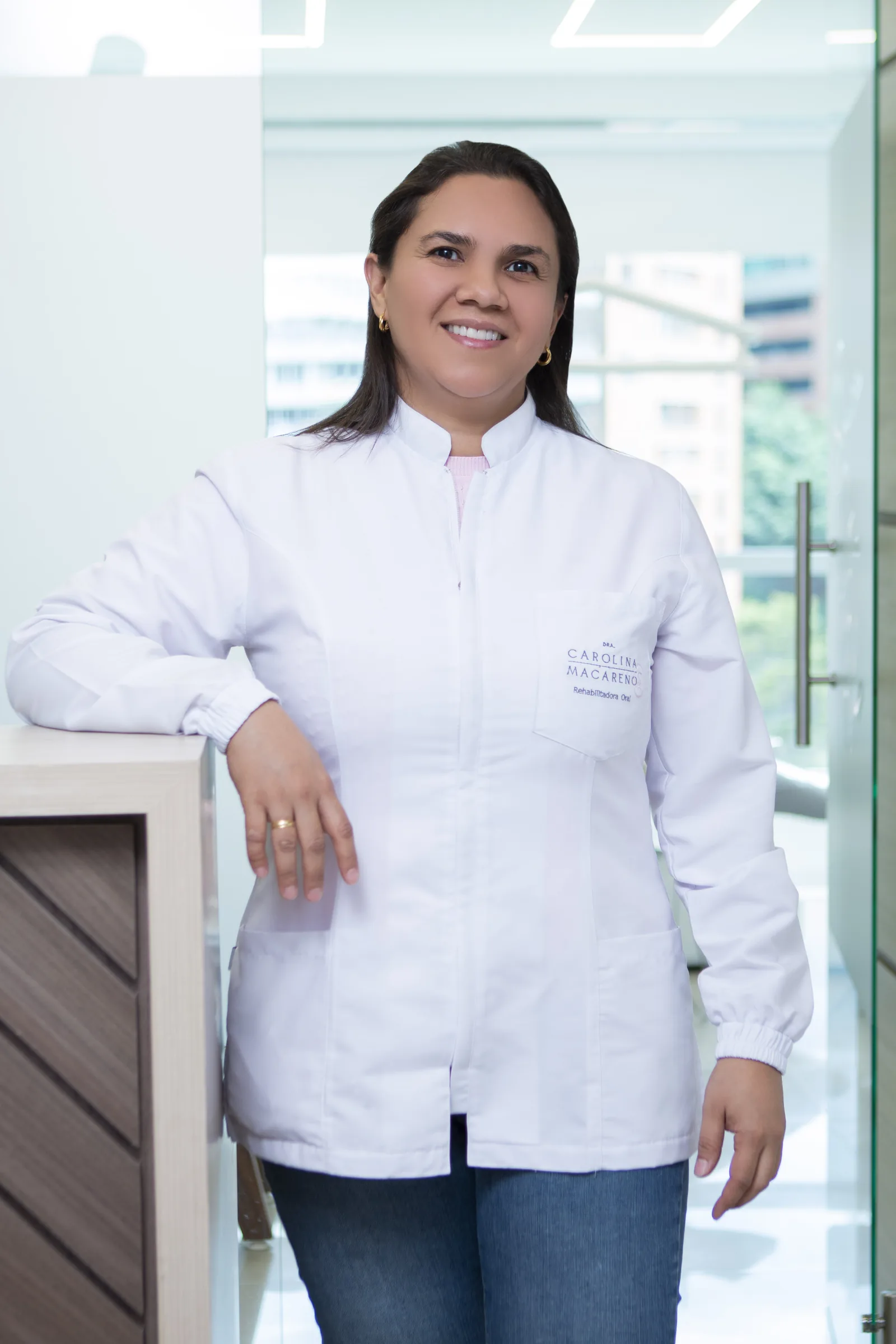
Dra. Carolina Macareno
Rehabilitadora Oral · Especialista en Implantes
Oral Rehabilitation specialist from Universidad CES. Over 17 years transforming smiles in Medellín, Colombia.
Dr. Carolina Macareno, oral rehabilitation specialist in MedellínDo you have questions about this topic?
Book a diagnostic consultation and we will resolve all your questions in a personalized way.