An All-on-4 in Puerto Rico costs between $20,000 and $32,000 per arch. In Medellín, from $10,000, with the same implant brands and no interpreter needed. I explain what changes, what does not, and how to evaluate it without getting your hopes up too high.
There is a question that reaches me almost always the same way, written with the same words:
"Doctor, I am from Puerto Rico. Is it worth leaving the island for this?"
It is an honest question and it deserves an honest answer, not a sales brochure. Because when someone lives in United States territory, with dentists near their home, deciding to be treated in another country is not a light decision. It is money, it is time, it is trust.
So in this article I am not going to promise you anything. I am going to give you the real numbers, the real differences, and the reasons why it would (and would not) make sense for you.
Let us start with the uncomfortable part: money
I will put the figures first, because that is what everyone wants to know and it is annoying to read three paragraphs of introduction before getting there.
| Treatment | Puerto Rico (USD) | Medellín (USD) |
|---|---|---|
| Full All-on-4 rehabilitation (one arch, implants + fixed prosthesis) | $20,000 to $32,000 | from $10,000 |
| Single implant (implant + definitive crown) | $2,800 to $4,500 | $1,500 to $2,100 |
| Complete smile design (10 ceramic veneers) | $12,000 to $20,000 | from $6,500 |
The difference on a single-arch All-on-4 is, depending on the case, around $10,000 to $22,000 USD. On a single implant, between $1,800 and $2,500. On a complete smile design, it can approach $10,000.
Now, important, and I say it plainly: those are ranges, not quotes. Your real price depends on your bone, your gums, whether you need a graft, how many teeth must be removed, the material you choose. No serious professional can give you an exact figure without seeing your imaging. If someone gives it to you on WhatsApp without a scan, be suspicious.
Why is it cheaper if it is the same?
This is the question that separates the informed patient from the one who gets carried away.
It is not cheaper because the implant is worse. It is cheaper because the cost of running a clinic in Medellín (rent, salaries, liability insurance, dental lab) is a fraction of the cost of running one in San Juan or in the continental United States. The same Swiss titanium screw costs the same at the factory; what changes is everything around it.
And there is one part that matters a lot: in Colombia the dental lab is twenty minutes away, not a country away. The prosthesis is tried in, adjusted and returned the same day. That improves the result, not only the price.
The real objection: "why leave United States territory?"
This is where I want to be most candid with you, because this objection is legitimate and almost no one answers it head-on.
1. The implant brands are exactly the same
We work with Straumann (Switzerland) and Neodent (from the same Straumann group). These are not "dental tourism" brands. They are the same brands used by implant clinics in the United States and Europe, with the same scientific documentation behind them.
This has a practical consequence few people get explained: if one day, back in Puerto Rico, you need maintenance or an attachment replaced, any specialist working with those brands can help you. You are not stuck with an orphan system nobody recognizes. If you want to dig deeper, I wrote a full comparison in Straumann and Neodent: which implant to choose.
2. Same language, no interpreter, no half-translation
This sounds obvious until you live it the other way around.
Many Hispanic patients in the United States end up explaining their medical history in a language that is not their own, or depending on someone to translate. And in complex dentistry, nuance matters: exactly where it hurts, since when, what you feel when you bite, what scares you about the procedure.
Here you speak Spanish and you are answered in Spanish. Your informed consent is in Spanish. Your post-op instructions are in Spanish. Your family can call and understand what was done.
For a Puerto Rican, that point is not a detail: it is probably the biggest difference compared with other dental tourism destinations such as Costa Rica, Hungary or Turkey.
3. An oral rehabilitation specialist, not a general dentist
I am an oral rehabilitation specialist. My specialty is planning and restoring the function and esthetics of a complete mouth: bite, occlusion, prostheses, esthetics.
And here is something I want to make crystal clear because dental tourism lies a lot about this: implant surgery is performed either by me or by the team's maxillofacial surgeon. I am an oral rehabilitation specialist in esthetic dentistry and implantology. I plan the case, design the rehabilitation and handle the prosthetic phase. Who operates is decided on the first day of the evaluation and planning, based on the complexity of the case and the scheduled agenda.
That is not a weakness, it is how it should work. A complex case is not solved by one person doing everything. It is solved by a team where each person does what they trained for. I wrote about the surgeon's role in maxillofacial surgeon in Medellín.
4. The flight is short and the time zone is the same
From San Juan you reach Medellín in a trip of a few hours, usually with a short layover. You do not cross oceans or lose days adjusting. And Colombia keeps the same time zone as Puerto Rico for much of the year, so coordinating calls with your family or your job does not become a problem.
Compared with flying ten hours to Europe to save the same amount, the math of fatigue counts too.
What you do have to consider before deciding
I would not be honest if I only sold you the pretty part.
This is not solved in a long weekend. An implant treatment has a surgical phase and a prosthetic phase, and that translates into days of stay you must plan. The full logistics (how many days per treatment, one or two trips) I explain separately in how many days should I stay in Medellín for my implants.
Your Puerto Rico dental insurance probably covers nothing off the island. Verify it with your plan before traveling. And budget the flight, the lodging and the days off work inside your calculation, not separately.
Remote follow-up requires discipline. You will need a dentist in Puerto Rico for check-ups and maintenance cleanings. We coordinate that, but sustaining it is your responsibility.
And most important: always ask who does what. Who operates? Which implant brand will they place? Does the price include the definitive prosthesis or only the temporary one? What happens if something fails at month 8? If a clinic gets uncomfortable with those questions, that is your answer.
On how to evaluate the safety of the whole process, I have a complete guide in dental tourism in Colombia: how to do it safely.
Frequently asked questions
How much does an All-on-4 cost in Colombia compared with Puerto Rico?
In Medellín, an All-on-4 per arch (4 implants plus fixed prosthesis) starts from $10,000 USD. In Puerto Rico the same treatment goes from $20,000 to $32,000 USD. The difference is around $10,000 to $22,000 USD per arch, depending on the prosthesis material and case complexity.
Are dental implants in Colombia the same quality as in the United States?
The implant brand is the same: we work with Straumann and Neodent, the same systems used in implant clinics in the U.S. and Europe. What varies between countries is not the screw, it is the clinic's operating cost. What you should always verify is the specific brand and who performs the surgery.
Do you speak English or do I have to speak Spanish?
All care is provided in Spanish, which is your language. You need no interpreter and no translation of your medical history. Consents and post-op instructions are also in Spanish.
Is it better for me to go to Colombia or to the Dominican Republic, which is closer to Puerto Rico?
It depends on what you are prioritizing. If your only criterion is the lowest price, there are cheaper destinations than Medellín. If what you want is a team with an oral rehabilitation specialist, brands like Straumann and Neodent, and an in-house dental lab minutes from the clinic, that is where Medellín competes. Always compare implant brand, who operates and what the price includes, not just the final figure.
Does my Puerto Rico dental plan cover treatment in Colombia?
Local dental plans generally do not cover treatment outside their network, much less outside United States territory. Confirm it directly with your insurer before scheduling any trip and budget the treatment as an out-of-pocket expense.
Who performs the implant surgery?
The surgery is performed either by Dr. Carolina Macareno herself or by the team's specialist surgeon. She is a specialist in oral rehabilitation, esthetic dentistry and implantology: she plans the case, designs the rehabilitation and carries out the prosthetic phase. Who operates is decided on the first day of the evaluation and planning, based on the complexity of the case and the scheduled agenda. You can and should ask about each professional's background before deciding.
What now?
If you are in Puerto Rico and have been postponing a rehabilitation because the numbers did not add up, the first step is not buying a ticket. It is understanding your case.
Message me on WhatsApp, tell me what is going on and what you have been told before. If you have a recent panoramic X-ray or scan, send it. With that I can tell you with judgment whether you are a candidate, what options you have and what realistic range your treatment would fall into.
And if the honest answer is that you are better off solving it on the island, I will tell you that too.
See how the full process works for international patients or review in detail what an All-on-4 in Medellín includes.
Frequently asked questions
▸How much does an All-on-4 cost in Colombia compared to Puerto Rico?
In Medellín, an All-on-4 per arch (4 implants plus a fixed prosthesis) starts from $10,000 USD. In Puerto Rico the same treatment goes from $20,000 to $32,000 USD. The difference is around $10,000 to $22,000 USD per arch, depending on the prosthesis material and the complexity of the case.
▸Are dental implants in Colombia the same quality as in the United States?
The implant brand is the same: we work with Straumann and Neodent, the same systems used in implant practices in the USA and Europe. What varies between countries is not the screw, it is the operating cost of the clinic. What you should always verify is the specific brand and who performs the surgery.
▸Do you speak English, or do I need to speak Spanish?
Care is given in Spanish, which is your language if you are writing from Puerto Rico, and English-speaking patients are also attended. You do not need an interpreter or a translated clinical history. Consent forms and post-operative instructions are provided in the language you need.
▸Should I go to Colombia or to the Dominican Republic, which is closer to Puerto Rico?
It depends on what you are prioritizing. If your only criterion is the lowest price, there are cheaper destinations than Medellín. If what you want is a team with an oral rehabilitation specialist, brands like Straumann and Neodent, and an in-house dental laboratory minutes from the clinic, that is where Medellín competes. Always compare the implant brand, who operates and what the price includes, not just the final figure.
▸Does my Puerto Rico dental plan cover treatment in Colombia?
Local dental plans generally do not cover treatment outside their network, much less outside US territory. Confirm it directly with your insurer before scheduling any trip and budget the treatment as an out-of-pocket expense.
▸Who performs the implant surgery?
Surgery is performed by Dr. Carolina Macareno or by the specialist surgeon on the team. She is an aesthetic oral rehabilitation specialist and implantologist: she plans the case, designs the rehabilitation and carries out the prosthetic phase. Who operates is defined on the first day of evaluation and planning, according to the complexity of the case and the scheduled agenda. You can and should ask about each professional profile before deciding.
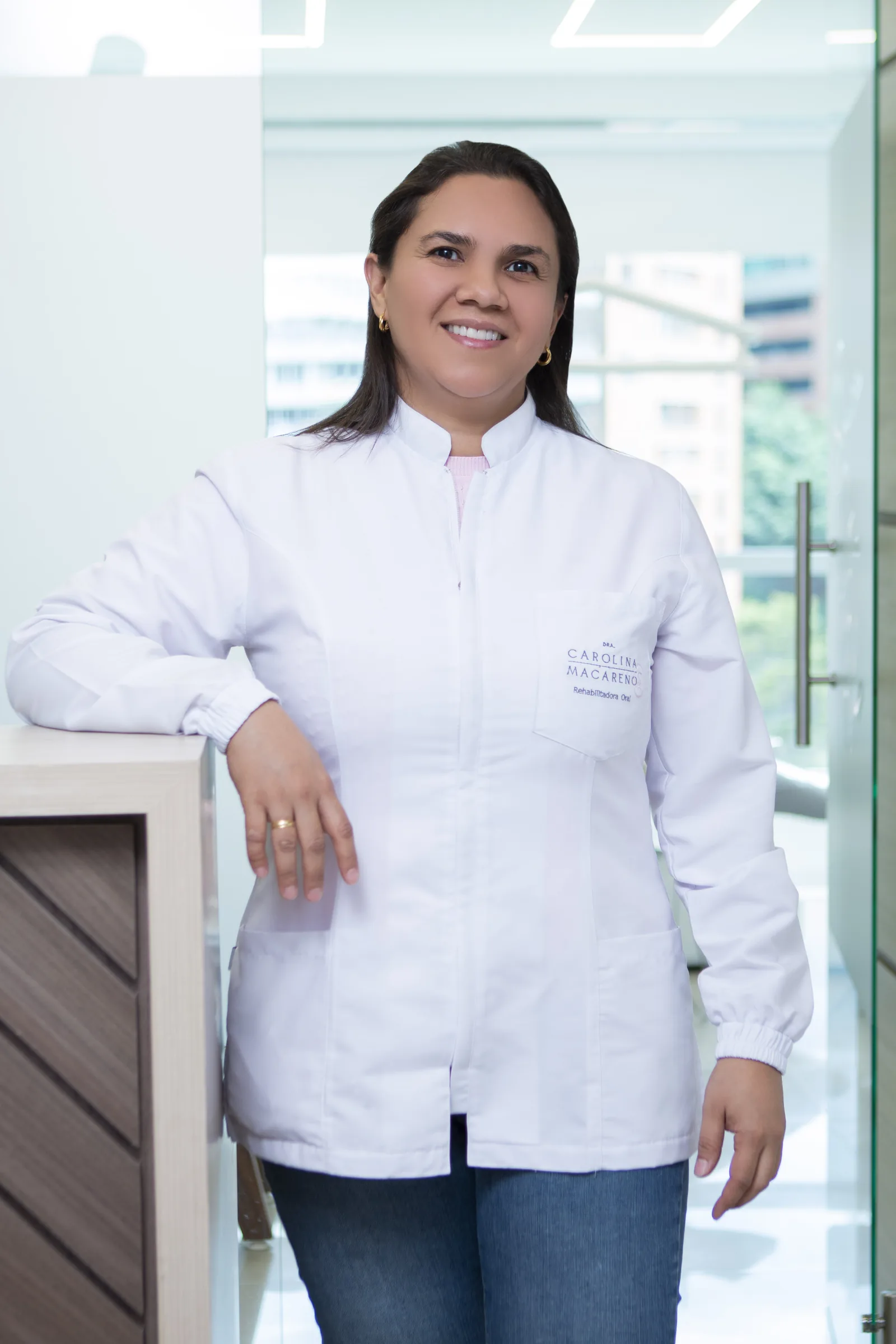
Dra. Carolina Macareno
Rehabilitadora Oral · Especialista en Implantes
Oral Rehabilitation specialist from Universidad CES. Over 17 years transforming smiles in Medellín, Colombia.
Dr. Carolina Macareno, oral rehabilitation specialist in MedellínReady to travel to Medellín?
Save up to 65% vs USA. Full USD quote before booking flights.