Advanced Oral Surgery · Atrophic Maxilla
Zygomatic Implants in Medellín
The solution for those who were told "you have no bone for implants". When the upper jaw is resorbed, the zygomatic implant anchors in the cheekbone, no grafts, and gives back fixed teeth in days.
Can I get implants if I was told I have no bone?
Yes. When the upper jaw lacks enough bone for conventional implants, zygomatic implants anchor in the cheekbone (zygoma) with no grafts needed, and allow fixed teeth, often with a provisional prosthesis in 24-72 hours. It is an advanced procedure that Dr. Carolina Macareno, an oral rehabilitation specialist with 17+ years in El Poblado, plans with 3D tomography. The plan and cost are defined at your assessment.
What is a zygomatic implant?
It is an implant longer than conventional ones, designed to anchor in the zygomatic bone, the cheekbone, instead of the upper jaw. When someone loses their upper teeth and time passes, the maxillary bone resorbs: it becomes so thin that it can no longer hold a normal implant. The zygomatic bone, on the other hand, is dense and stable, and almost never resorbs.
That is why the zygomatic implant solves cases other techniques rule out: instead of trying to rebuild lost bone with grafts and waiting months, it finds solid anchorage where bone does exist. It is the difference between "it can't be done" and "it can, with no grafts and in less time".
Is this treatment for you?
- ✓You were told at another clinic that you "have no bone" or that you are not a candidate for upper implants.
- ✓You have worn an upper removable denture for years that moves, hurts or feels uncomfortable.
- ✓You had bone grafts or sinus lifts that did not work, or you want to avoid them.
- ✓You had upper-jaw implants that failed due to lack of bone.
- ✓You lost bone from advanced periodontal disease, trauma or previous surgery.
- ✓You want fixed, not removable, teeth in the shortest time possible.
Advantages over graft-based techniques
For the patient with an atrophic upper jaw, the zygomatic usually means fewer surgeries, less waiting and a fixed result.
No bone graft needed
Avoids bone reconstruction and sinus lift, and the 6 to 12 months of waiting they usually involve.
Fixed teeth in days
In many cases a fixed provisional is placed in 24-72 hours (immediate or early loading), depending on the evaluation.
Bone that does not resorb
The cheekbone is dense, stable bone, giving reliable support even when the upper jaw no longer has it.
Success rates above 95%
Long-term studies back the procedure when performed by a specialist with 3D planning.
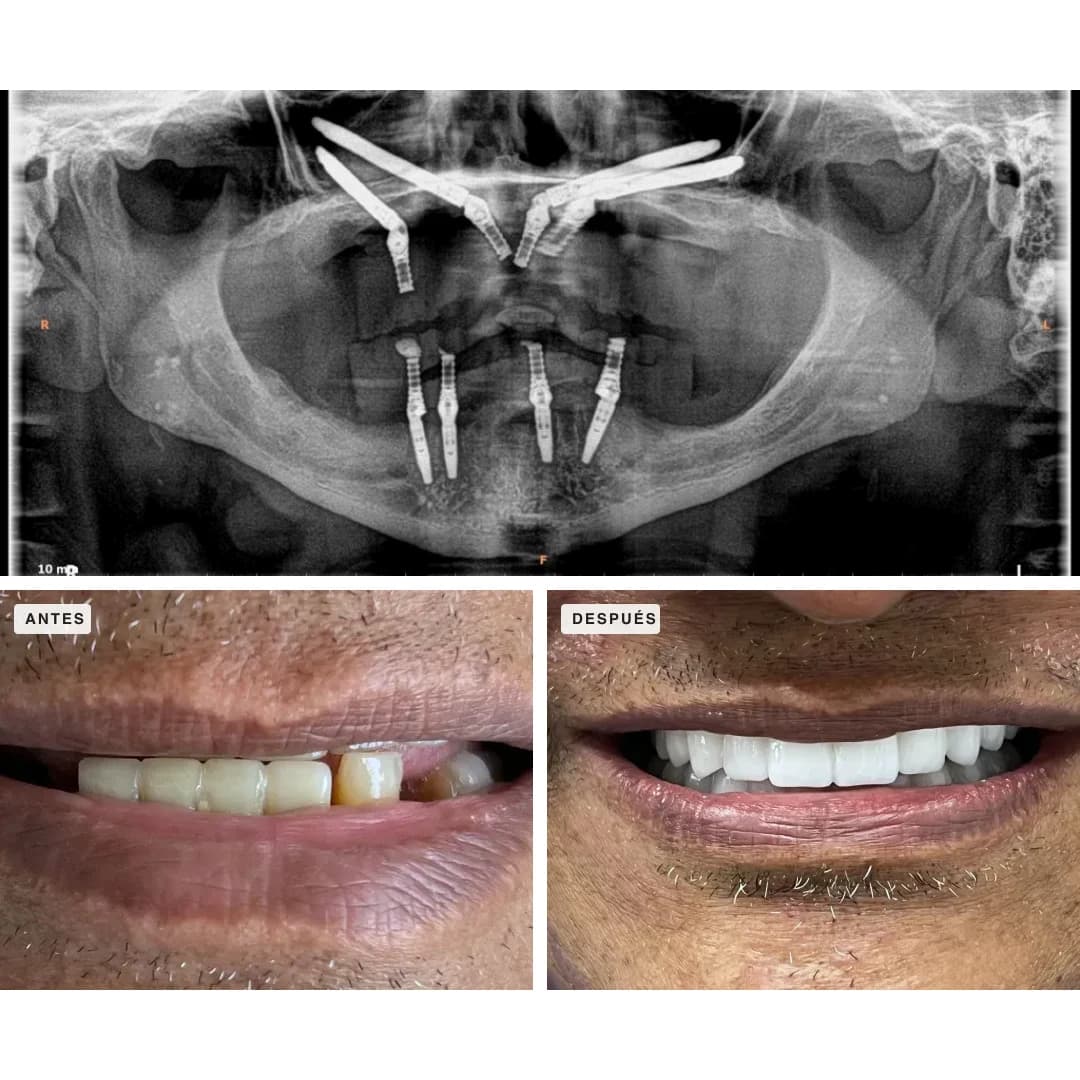
Zygomatic implants anchored in the cheekbone (radiographic image)
A specialist procedure, not a routine one
3D diagnosis before deciding
CBCT tomography to measure available bone and plan the exact implant path away from the sinus and orbit.
General anesthesia in an operating room
As it involves a delicate anatomical area, the procedure is preferably performed under general anesthesia in an operating room, with prior digital planning.
17+ years and 3,500+ patients
Advanced training in implantology (FACOP) and aesthetics (NYU). Oral rehabilitation as a specialty, not a general service.
Brands and compatibility
We work with recognized systems (Straumann, Neodent, DioImplant) and restore the full case through to the fixed prosthesis.
The process step by step
Assessment and 3D diagnosis (CBCT)
Tomography, photos and full evaluation. We confirm whether the jaw is a candidate for zygomatics and design the plan with costs.
Digital surgical planning
We define the number of implants (usually 2 or 4) and the exact path, avoiding the maxillary sinus and orbit.
Placement surgery
Procedure preferably performed under general anesthesia in an operating room. Zygomatic implants anchor in the cheekbone; they may be combined with conventional anterior implants.
Fixed provisional prosthesis (immediate/early loading)
In many cases a fixed provisional prosthesis is placed within 24-72 hours, so you leave with fixed teeth.
Final prosthesis
After healing, the definitive fixed prosthesis is made and placed in high-strength materials (zirconia/ceramic).
Checkups and maintenance
Regular follow-up and personalized hygiene to care for the implants and tissues long term.
Indication
Upper jaw without bone
Bone graft
Not required
Fixed teeth
In 24 – 72 h (case-dependent)
Frequently asked questions
▸What are zygomatic implants and who are they for?
Zygomatic implants are long implants that, instead of anchoring in the maxillary bone (which may be resorbed), are fixed in the zygomatic bone, the cheekbone. They are indicated for upper-jaw patients with severe bone loss who were told they "have no bone" for conventional implants, people who have worn a removable denture for years, or cases of failed previous grafts or implants.
▸How much do zygomatic implants cost in Medellín?
The cost depends on how many zygomatic implants the case requires (usually 2 or 4), whether they are combined with conventional implants, and the type of fixed prosthesis. By avoiding the bone grafts and months of waiting that other techniques demand, it often resolves in fewer surgeries a case that was previously considered unviable. The exact figure is defined at your assessment with 3D (CBCT) diagnosis.
▸Can I have fixed teeth if I have no bone in my upper jaw?
Yes. Zygomatic implants make it possible to restore a full upper arch with fixed teeth even when there is not enough bone for conventional implants, with no grafts needed. In many cases a fixed provisional prosthesis is placed within the first 24 to 72 hours (immediate or early loading), depending on what the evaluation indicates.
▸Do I need a bone graft for zygomatic implants?
No. The main advantage of the zygomatic implant is precisely that it avoids bone grafting and sinus lift. Instead of "rebuilding" the lost bone (a process that can take 6 to 12 months), the implant finds solid anchorage in the cheekbone, which almost never resorbs. This shortens treatment considerably.
▸Is zygomatic implant surgery safe?
It is an advanced procedure that demands precise 3D planning and surgical experience, since the implant passes near the maxillary sinus and the orbit. Performed by a specialist with CBCT tomography, guided surgery and preferably under general anesthesia in an operating room, it has documented success rates above 95% in long-term studies. Your assessment determines whether it is the right technique for your case.
▸Do zygomatic implants work for the lower jaw?
No. Zygomatic implants are exclusive to the upper jaw, because they anchor in the cheekbone. For severe bone loss in the lower jaw (mandible) there are other solutions, such as custom-made subperiosteal implants or regeneration techniques. Your assessment defines the correct option for your anatomy.
Real clinical case
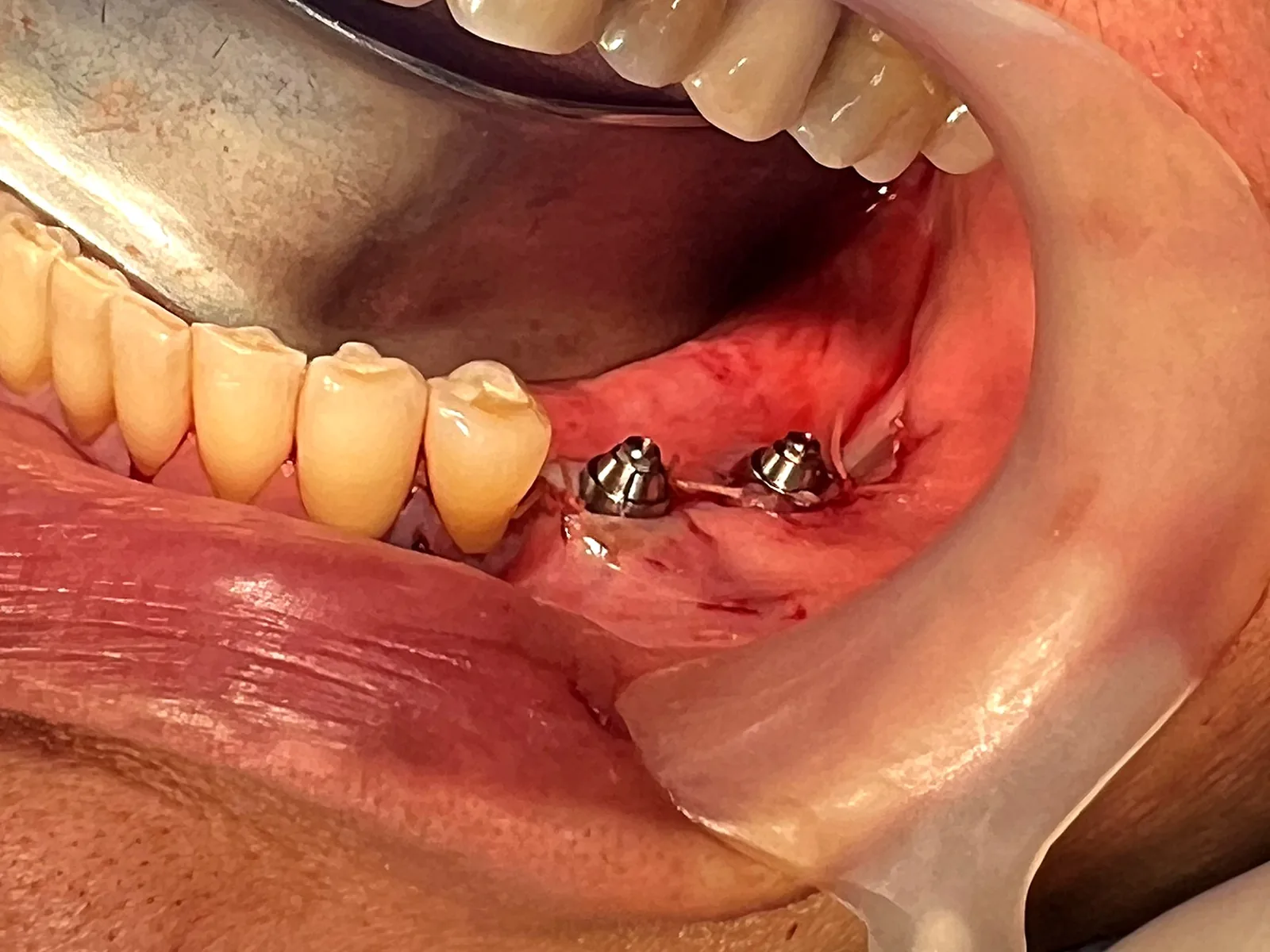
Custom subperiosteal implant, step by step
When there is no bone left for a conventional implant and the jaw is severely resorbed, the custom subperiosteal implant rests on the bone. See the real documented case: 3D planning, surgery and post-surgical result.
See full clinical caseWere you told there was no solution?
Send your case via WhatsApp or book an assessment with 3D diagnosis. Many cases other clinics rule out do have a path with zygomatic implants.